

.jpg)


 00:09
00:09
 Tissue Culture Banana Cultivation Technology

Banana Bunch Care and some proven procedures
to maximize the Bunch size:

To
attain maximum yield in Banana cultivation, follow the latest cultivation practices give here:
 |
| A model of 'DBT' certificate |
- Prefer Tissue culture banana plants from 'DBT' (Department of Biotechnology) certified biotech companies.
- Avoid cultivating banana in problematic soils like ‘Acidic’, ‘Alkaline’ and ‘Saline’ soils.
- Ensure irrigation water quality and avoid water with EC of >1.
- Give priority to good water management (To avoid water Stress, go for Drip irrigation system).
- Adhere to a strict Integrated Nutrient Management (INM covers NPK, Macro and Micro-nutrients) schedule as given in the following links: Fertigation schedule for banana and Fertilizer target chart for banana (along with the comments section in both the posts).
- Follow good Integrated Pest Management (IPM) practices.
- Follow good Integrated Disease Management (IDM) practices.
- Strictly follow all the 'Bunch care techniques' explained here to maximize bunch size. Always bear in mind that the price of Banana is NOT directly in proportionate to the quality of produce. In the trading of banana, fruit quality is valued more in fixing the price. So, strive to achieve the best in quality.
Details of Banana Bunch care & methods
to enhance the bunch size:
1. Bell injection - Injection on inflorescence bud to control sucking insect pests infesting on developing fingers:

Bell Injection is given when the emerging inflorescence (Flower) bud is in upright position. It gives complete protection from pests that damage the developing bunch as the bell emerges.
The injection should be given at 1 / 4th place from top of the bud.
To prevent clogging of the needle, first make a hole at the desired point with a small needle and then use the syringe.

Prepare a solution of Imidacloprid 17.8 EC (Brand:
Confidor) @ 0.2 ml in 1 litre of water and take 2 ml solution in a
disposable Insulin syringe. Inject the entire 2 ml in the bud in a 30
degree angle.
(OR)

Prepare a solution of 0.1% (One ml in 1 litre of water) of Imidacloprid 17.8 EC (Brand: Confidor) and pump a full single dose of 40 ml of the solution into the flower bud thereby fully drenching the bud using "Banana Bell Injector pump".
 |
| Pictures courtesy: http://treeinjectors.com/ and http://www.saspl.com.au/product/banana-bell-injection-poster-2/ |
2. Banana Deflowering:
 |
| Banana Deflowering |
3. Placing perforated sheet as cushion between separated hands:
 |
| Placing perforated sheets between hands |
.
.
4. De-navelling (Removal of male floral bud):

It helps in fruit development and increase of bunch weight.
The male flower bud should be removed one month after emergence of the last hand.
By this removal of unwanted male flower bud, which is prone to infections, incidence of pest and disease attack on bunch can be minimized.
In some parts of Tamilnadu, farmers leave them as such up to the time of harvest, resulting in elongation of stem with the male flower bud up to the ground.
5. Covering the peduncle (Peduncle wrapping) to protect it from sunburn or scorching:
 |
| Flag leaf / Boot leaf - Nature's umbrella Gift. |
A 'Boot leaf / Flag leaf ' emerges from the plant just before the bunch emergence and its main purpose is to protect the top curved part of the peduncle and upper portion of the bunch from sunburn or scorching.
If this natural protection gets damaged due to wind or pest attack, the upper exposed part of peduncle will get sun burned (Sun scorched).
This subsequently leads to rotting of peduncle due to secondary infection of 'Colletotrichum fungus'. Incidence of sun scorching will be severe if bunch emergence coincides with hot summer months. Since nutrient and water flow from the main stem to bunch gets arrested, immature ripening will occur resulting in very poor bunch development and ultimately breaking of the peduncle along with the bunch.
Remedial measures: - To prevent sunburn and the resultant fungal infections, the peduncle exposed to scorching sun should be wrapped with the flag leaf and other banana leaf trashes.
- If the sun scorching happens before initiating any protective measure, apply a thick solution of 2% COC (Fytolan or Blue Copper) on the affected area using a wall painting brush and cover the affected portion using banana trash leaves.
6. Effects
of covering Banana bunch (Skirting) with polythene Bunch covers / sleeves or Non-woven skirting bags :
 |
Usage of Banana bunch cover
|
- Bunches are covered with 6% ventilated Polythene covers / sleeves of size 200cm Length x 150cm width x 175 gauge thick.
- Use opaque polythene covers / sleeves if bunch development is during winter and paper bags can also be used to avoid chilling injury at frost conditions.
- Use blue color bunch cover / sleeves during summer to avoid sun scorch.
- Do it within 15 days of last hand opening.
- The bunch is free from insect bites, fungi, bacteria attacks and physical injuries.
- Improved bunch appeal.
- Maturity of bunch will be advanced by 7 to 10 days.
 |
| Placing inserts and skirting the bunch with covers / sleeve |
 |
| Using blue color bunch covers / sleeves during summer to avoid sun scorch. |
 |
| Using Bunch cover made of paper to prevent chilling injury at frost conditions |
7. At the banana bunch development stage the
following fertilizers are normally recommended to enhance the size of fruits /
bunch:
Option 1: Application of 2% (20gm / 1litre) Potassium sulphate
(0:0:50) as foliar spray on bunches, two times with 15 days interval.
(OR)
Option 2: Application of 1% (10gm / 1litre) Potassium
nitrate (13:0:45) as foliar spray on bunches, two times with 15 days
interval.
(OR)
Option 3 (Considered as best since it addresses all nutritional deficiencies): Application of 0.5% (5gm / 1litre) Potassium
nitrate (13:0:45) + 0.5% (5gm / 1litre) of foliar grade Micro nutrient
mixture as foliar spray on bunches as first spray followed by a second
application of 2% (20gm / 1litre) of Potassium sulphate (0:0:50) + Biozyme 2ml
/ 1litre after 15 days. Repeat the second one again as III application after 15 days interval.
Important Note 1: In all the above applications you can also add 0.2%
Bavistin (Fungicide) for prophylactic control of fungal infections. Use wetting agents also.
Important Note 2: Nowadays farmers
are going for a minimum of four applications within a period of 60 days (4
sprays with 15 days interval between each spray) and are getting very good
results.
Precautions:
- Care should be taken to spray the above fertilizers only after all the hands are fully opened and after sufficient extension of male flower bud in the rachis.
- Do not apply any fertilizers or pesticides 15 days before harvest since there is a possibility of the unabsorbed chemical residues entering human food chain.
- Application of excess dosage of fertilizers, Enzymatic and synthetic Growth promoters and plant protection chemicals on bunches are to be strictly avoided. See the link:Effect of overdose.
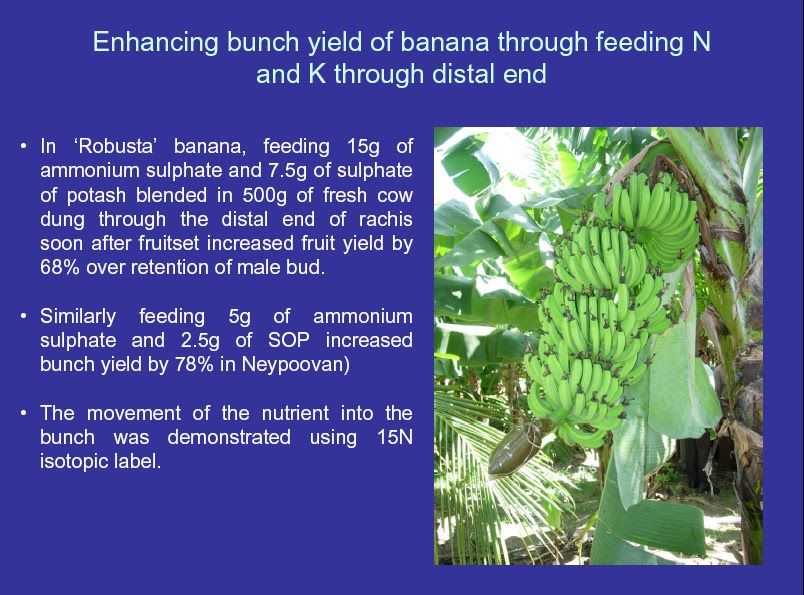
Option 4: Enhancing banana bunch yield through feeding N and K through distal end of rachis: For detailed procedure click this Link.
There is considerable increase in
bunch size in ‘Robusta’ and ‘Grande naine’ banana, when feeding the
following mixture through the distal end of rachis soon after fruit set.
Preparing the nutrient mixture:
- Ammonium Sulphate - 15gm
- Sulphate of potash (SOP) - 7.5gm
- Fresh cow dung - 500gm blended in 100 ml of water.
(Cow urine can also be used instead of
water. 500 gm of fresh cow dung contains substantial amounts of about
5.5gm of N, 3.5gm of K 1.6 gm of S besides other minerals and
bio-chemicals).
Method of application:
v Select
bunches where the fruit set is complete and about 10 – 15 cm long
rachis is available after the last hand. Avoid bunches where fruit set
is incomplete or during partial deflowering time.
v Remove male flower bud close to the rachis.
v Take the already prepared nutrient slurry in a used milk bag.
v Insert the slurry filled bag into the de-navelled stalk end of the bunch and tie it with a strong string.
Benefits:
Ø Bunch
weight increased by 67% over control in which male flower bud was
retained till harvest. In the field demonstrations, a response of 22 %
to 28% increase in bunch weight was evident. Using ‘N-isotope label the
movement of 51% of N into the bunch from AmSo4 was confirmed.

(Courtasy: ICAR News, Research update, Success story, April – June 2007).
For
EXPORT of banana fruits, buyers normally insist on the following practices also
in addition to the ones described above:
8. Size of fruit preferred for export:
8. Size of fruit preferred for export:
 |
| 41mm fruit measuring tool kit |
- Exporters won’t prefer fully developed bunches that are ready for harvest. A bunch with a middle fruit in It’s 2nd hand measuring 41 mm dia, and the middle fruit in the last Hand with 35 mm dia two weeks before harvest is ideal for Export.
- Normally there will be variation in the size of fruits located in the upper hands and lower hands. Fruits in the upper hands are always bigger than fruits in lower end hands. The variation will be more and markedly visible if there are more than 10 hands (sometimes 13 to 15 hands) in the bunch. To procure more or less uniform size of fruits, exporters insist the farmers to maintain only 9 or 10 hands in the bunch. By restricting the number of hands to 9 to 10, availability of nutrients to the fruits are more resulting in uniform size of fruits and faster development.
 |
| 41mm is preferred fruit size for export |
 |
10. Retaining a finger in the last hand:
After de-navelling (removal of male floral bud), the distal end of rachis sometimes
gets infected with fungus and if left uncured the fungal infection spreads
to the upper hands causing extensive damage. Retaining a finger in the
last hand is a practice to monitor the fungal infection since the symptoms
can be easily spotted in a lone fruit rather than spotting it in the major
part of the bunch.
 |
| Leaving a single finger in the last hand |
Excellent yields are obtained in many fields of farmers at Theni District, Tamilnadu, where the farmers followed only few of the bunch care techniques described here above. But, they meticulously followed the 'Bunch sprays' described in Sl.No.6, Option 3, Important Notes 1 & 2 and covered the bunches with bunch covers / sleeves. To attain max. yield in banana, the crop has to be nourished properly from day one. One of the main reason for the farmers achievement other than bunch care and bunch sprays is their adherence to the "Fertilizer Target Chart" (Link: Fertilizer Target Chart for better nutrition management in banana - Kindly refer the comments section also for better understanding) given to them for giving timely, adequate and balanced nutrition to the crop.


A.Vishnu Sankar.
 Posted in: