A Plant Inoculation Room (PIR) in a Tissue Culture Lab:
Trained technicians working in LAF cabinets at Plant Inoculation Room. All TC Labs should have demarcated clean area for Plant Inoculation Rooms (PIR) having stringent sterility conditions (Class 100-10,000 air quality)
A plant growth room in a Tissue Culture Lab:
All TC Labs should have demarcated clean area for both Plant Inoculation Rooms (PIR) and Plant Growth Rooms (PGR) having stringent sterility conditions (Class 100-10,000 air quality)
A plant growth room in a Tissue Culture Lab:
All TC Labs should have demarcated clean area for both Plant Inoculation Rooms (PIR)and Plant Growth Rooms (PGR)having stringent sterility conditions (Class 100-10,000 air quality)
T.C Plants in JIFFY POTS :
Tissue culture Grande Naine plants raised in Jiffy pots in their holding tray.
A secondary hardening centre:
Many Polyhouses of this kind with a capacity to accomodate 1 Lakh plants each are required depending upon the production capacity of the unit.
Field with excellent yield!
A Tissue culture Grande naine Banana bunches under development. Farmer:Murugan,Gudalur, Theni Dt, Tamilnadu.
Robust and Uniform Bunches !
A charcteristic feature Tissue culture Banana plants are the uniformity of bunches in all the trees in a given field.
Friday, 22 July 2011
Tuesday, 19 July 2011
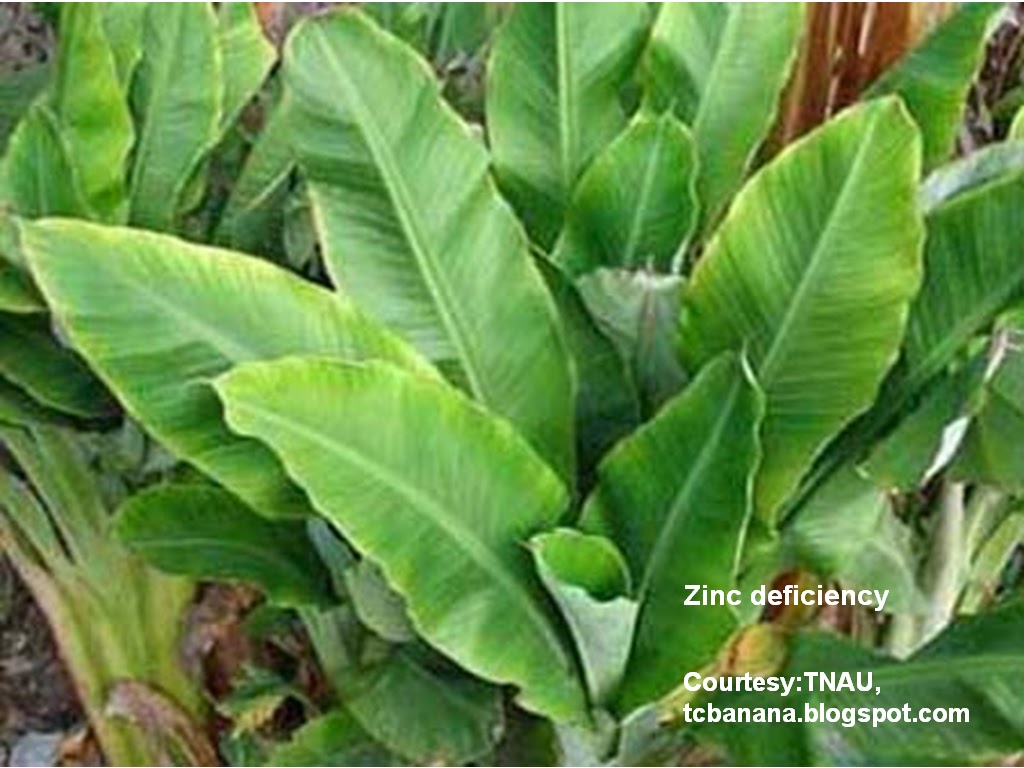
Zinc (Zn) deficiency symptoms
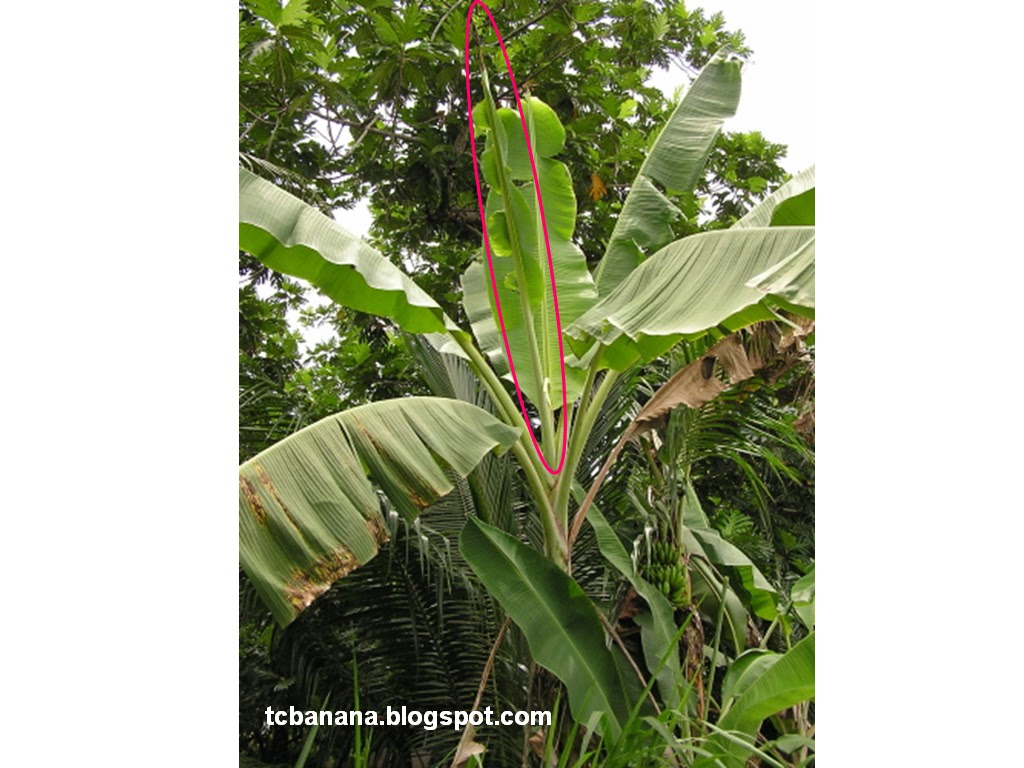
- Narrow pointed and chlorite young leaves, bunchy top crowns are the symptoms of zinc deficiency which is often falsely identified as BBTV by the farmers.
- The young emerging leaves have high amount of anthocyanin pigment on the lower side of the leaves, which often disappears as the leaf unfolds.
- Leaves are narrow with yellow to white stripes between the secondary veins.
- Later on oblong, brown or necrotic patches develop on the yellow striped areas.
- The leaves of the young suckers may become distorted, comprising of mid-rib and serrated narrow lamina only.
- Bunches developing on such plants have twisted fingers with prominent light green tip.
- The characteristics symptoms appear in young leaves which become significantly smaller in size and more lanceolate in shape.
- Manual application of Zinc sulpahte @ 2g/plant.
- Spray chelated Zinc @ 2-3 g/1 of water at 7-10 days interval till deficiency symptoms disappear.
- For ratoon crop apply the above preparation 45 days after cutting the mother plant.
Posted in: 36. Zinc (Zn) deficiency symptomsThursday, 14 July 2011
Boron (B) deficiency symptoms
- Symptoms include marginal leaf curing and deformation, and most commonly white stripes appear perpendicular to the veins on the young emerging leaves.
- The new leaves may have an incomplete lamina similar to sulphur and calcium deficiency with thickening of secondary veins.
- Inhibition of root and flower formation is also observed in the affected plants.
- Boron and Calcium deficiency symptoms tend to overlap. See Calcium deficiency pictures also.
- Once a plant shows of signs of deficiency, take immediate remedial steps suggested here below, since the plants will not fully recovery once the damage is already happened.
(OR)
(OR)
c. Spray Solubor @ 1g/litre of water 2 times in a month. (Excess application will harm the plant).
(OR)
d. Apply Sodium tetraborate @ 25 gms per plant and irrigate immediately.
Posted in: 34. Boron (B) deficiency symptomsTuesday, 12 July 2011
IRON (Ferrous-Fe) deficiency symptoms
- Leaves exhibit white/yellow chlorosis of the entire lamina and green band along the margin and mid-rib.
- The chlorosis is more acute in spring and autumn than in summer, and is more evident under dry conditions.
- Plants are generally stunted and the fruits are smaller in size.
![]() |
| Very severe stage of Ferrous deficiency |
![]() |
| Ferrous deficiency in early stage |
![]() |
| Ferrous deficiency symptoms in calcareous soils |
Regards,
Posted in: 33. IRON (Ferrous-Fe) deficiency symptomsThursday, 7 July 2011
Manganese (Mn) deficiency symptoms
- Plants exhibit “comb-tooth” leaf chlorosis and the presence of fungus- Deightoniella torulosa in the chlorotic areas.
- The chlorosis starts from the leaf margins and spreads along the veins towards the midrib with interveinal areas remaining green, hence the comb-tooth appearance.
- Leaves desiccate prematurely causing poor fruit development.
- Normal size bunch is produced by the plant but the fruits are covered with black spots.
Posted in: 35. Manganese (Mn) deficiency symptomsWednesday, 6 July 2011
Calcium (Ca) deficiency symptoms
- Young leaves show interveinal chlorosis near the margins and towards the tip.
- When these chlorotic patches die they create a serrated necrosis along the leaf margin.
- A temporary shortage of calcium causes the “spike leaf” symptoms in the field in which the lamina of new leaves is deformed or almost absent with thickened lateral veins near the mid-rib and deficient root system which is susceptible to rot.
- Fruit quality is inferior and the peel splits when the fruit is ripe.
Yellow stripes parallel to leaf midrib.
Picture 2: Ca deficiency-Early foliar symptom -
Yellow stripes parallel to leaf midrib.
Picture 5: Boron and Calcium deficiency - "SPIKE LEAF" (in which the lamina of new leaves is deformed or almost absent).
Sources of Calcium:
Lime
Gypsum
Calcium nitrate
Superphosphates
Regards,
A.Vishnu Sankar
Posted in: 30. Calcium (Ca) deficiency symptomsMonday, 4 July 2011
CONTIGENCY PLANS
CONTIGENCY PLANS . . . . .
|
Posted in: 19. Contigency plansCALENDAR OF AGRICULTURAL OPERATIONS FOR BANANA:
Preparation of land:
Selection of Suckers:
Sucker Treatment and planting:
· The selected suckers should be ‘pared’ by trimming of all the roots along with surface layers superficially to remove any rotten portion of the corm.
· Dip the pared suckers in 0.2% Carbendazim (2g/litre of water) solution for about 15 –20 minutes as a prophylactic measure against Fusarium wilt disease.
· Keep the treated suckers in shade overnight before planting. Plant the suckers in the center of the pit and press the soil around the suckers firmly.
· Apply 40 g of Carbofuron granules per pit to protect the plants against nematode attack and irrigate the field thoroughly.
|
CALENDAR OF OPERATIONS.....
|
During First month
· The soil around the plants should be pressed firmly for better and quick establishment of the plants.
· Wherever necessary, ‘Gap Filling’ should be done to replace the un- sprouted as well as rotten suckers. Seeds of green manure crops viz., cowpea or sunnhemp be sown.
· For additional income and also for effective land use efficiency, short duration crops such as onion, green gram, black gram, beans, radish, greens, marigold and short duration vegetables can be grown as intercrop.
· Tomato, chilly and cucurbits should not be grown as intercrop since these crops harbour nematodes and aphids, which act as vector of virus spread.
|
Second Month
· Green manures viz., cowpea or sunnhemp should be ploughed back in to the soil at flowering stage or about 40 days after sowing.
· Slight digging and earthing up to keep the weeds under control.
· For Fusarium wilt susceptible varieties like Rasthali, Karpuravalli, Ney Poovan, Monthan and Pachanadan, drench the soil around the plant with 0.2% Carbendazim as a prophylactic measure, or
· Apply 30g Trichoderma viride or Pseudomonas flourescense along with FYM/compost 1 kg in the soil around the plant as a prophylactic measure for the control of wilt disease.
|
Third Month
· Application of 40g of Carbofuron to control nematodes.
· Digging and weeding.
· Application of first dose of fertilizers @ 100:300:100 g Urea, Super Phosphate and MOP per plant in basins made about 30 cm away from the plant.
|
Fourth Month
· Application of Azospirillum and phosphobacteria @ 30 g and Trichoderma viride @ 30g along with 5-10 kg FYM plant-1.
· There should a gap of minimum 2-3 weeks between the application of chemical fertilizers and biofertilizers.
· Periodical removal of side suckers by cutting them above the ground level and pouring 2 ml kerosene at the central core of the sucker.
· If any virus affected plants are noticed in the field, remove and destroy it immediately and spray with any systemic insecticide to kill the insect vectors which spread the virus.
|
Fifth Month
· Application of second dose of fertilizers @ 150:150 g Urea and MOP+ 300g neemcake per plant in the basins made about 45 cm away from the plant.
· Removal of dried leaves.
· Digging and weeding.
· To cater the micronutrient need of the plant and to correct their deficiency, apply 50g agricultural lime and 25g magnesium sulphate per plant.
· For Fusarium wilt susceptible varieties like Rasthali, Karpuravalli, Ney Poovan, Monthan and Pachanadan drench the soil around the plant with 0.2% Carbendazim as a prophylactic measure.
· To prevent the egg laying and further attack of stem weevil, spray ‘Neemosol’ @12.5ml/litre or Chlorpyriphos @ 2.5ml/litre on the stem especially in Nendran, Red banana, Karpuravalli and Monthan varieties.
· To monitor the corm and stem weevil, 2 ft long longitudinal stem trap @40 traps/acre can be placed at different places. The collected weevils are to be killed using kerosene.
· Keep the banana fields as well as surrounding areas weed free and spray systemic insecticides to control the insect vectors.
|
Sixth Month
· Digging and earthing up of soil around the plant.
· Removal of the dried and diseased leaves and spraying of 0.1% Propiconazol (TILT) by thoroughly covering both the surfaces adding wetting agent with the spray fluid especially during winter and cool months for control of Sigatoka leaf spot diseases.
· Yellowing of leaves which is a symptom of iron deficiency, spray 0.5% ferrous sulphate + 1.0% urea added with wetting agent on the leaves especially in high pH >8.5 and Calcareous soils.
· To correct the deficiency of zinc, spray 0.5% zinc sulphate solution along with wetting agent.
· Foliar application of 0.5 Borax is recommended to correct the deficiency.
· Apply 30g Trichoderma viride or Pseudomonas flourescense in the soil around the plant as a prophylactic measure to control the wilt disease.
· For controlling the stem weevil attack, using ‘Banana Injector’, inject 2ml of Monocrotophos (150 ml Monocrotophos mixed in 350 ml of water) at 2 and 4 feet height on opposite direction.
|
Seventh Month
· Application of third dose of fertilizers @ 150:150 g Urea and MOP per plant in the basins made about 60 cm away from the plant.
· Removal of the dried and diseased leaves and spraying of 0.1% Carbendazim or Calixin by thoroughly covering both the surfaces along with wetting agent.
· Periodical removal of side suckers by cutting them above the ground level, scoop the core and pour 2 ml kerosene in the core.
· Injection of 2ml of Monocrotophos using ‘Banana Injector’ at 2 and 4 feet height for the control of stem weevil.
|
Eighth Month
· After flowering, only one healthy side sucker should be allowed for first ratoon and the remaining suckers should be killed using kerosene or uprooted.
· Spraying of 0.1% Indofil by thoroughly covering both the surfaces.
· After the emergence of the last hand, the male bud has to be removed leaving about 15 cm stalk from the last hand.
· To prevent ‘cigar end rot’ disease, remove the pistil and perianth carefully from the fully emerged fingers and spray the bunch with Indofil M-45 @ 2.5 ml/litre.
· Spray 2% Potassium Sulphate (20g/litre of water) solution with surfactant by thoroughly drenching the bunch and cover the bunch with 100 gauge thick white or blue polythene sleeves having 6% ventilation.
|
Ninth Month:
· Thirty days after the first spray, give a second spray of 2% Potassium Sulphate (20g/litre of water) solution with surfactant by thoroughly drenching the bunch.
· Provide casuarina pole or bamboo support to the plants for tall and heavy bearing bunches.
|
Plant population under different planting systems
| ||||||||||||||||||||||||||||||||
Drip Water requirement at different growth stages of banana
* Depending on the season
|
Weekly Fertigation Schedule for banana (g/ plant / application)
|
Posted in: 17. Calendar of cultivation

20:41
Tissue Culture Banana Cultivation Technology