For growth and prosperity

For growth and prosperity

Friday, 5 December 2014

Insect Pests – Pseudostem Weevil / Borer


Insect Pests – Pseudostem Weevil / Borer:
Symptoms:
The Pseudostem weevil (Odoiporus longicollis) are normally black coloured ones but red coloured variants are also found in some areas. The pest breeds and become more active during summer and monsoon seasons.
Early symptoms of infestation are the presence of small pin-head sized holes on the pseudostem, fibrous extrusions from bases of the leaf petioles and exudation of a gummy substance from the holes of the pseudostem.
The weevil larvae are fleshy and yellowish white. Larva bores hole through the pseudostem and thrives inside. This results in exudation of plant sap followed by dropping of the faecal matter. As the central core is destroyed due to the boring of the larvae, upward movement of the nutrient is hampered which ultimately results in poor growth and development of the plants.
If the larva tunnels pseudostem during advanced pre-flowering stage, the ascending flower bud and peduncles are destroyed resulting in non emergence of the flower bud which decays inside the pseudostem. This leads to choked throat appearance of bunch and breaking of Pseudostem.
During advanced stages of infestation, we can observe by splitting the stem, the pests' extensive tunneling both in the leaf sheath and in the rhizome. Rotting occurs due to secondary infection of other pathogens and foul odour is emitted. When the rhizome and peduncle are tunnelled after flowering, the fruits do not develop properly, exhibiting a dehydrated condition with premature ripening of the bunch.

Pseudostem weevil affected plant with immature bunch

Pseudostem weevils / grubs


Pseudostem weevil attack - Bore hole on Banana
 Control:  
  1. Keep the plantation clean.  
  2. Remove trashes and burn the refuse. 
  3. Do not dump infected plant into manure pit. 
  4. Uproot infected trees, chop into pieces and burn. 
  5. You can be rest assured of infection free planting material if you go for ‘Tissue culture plants. If you opt for suckers, then avoid planting of borer infested suckers. To make sure that you have clean suckers, the roots should be trimmed and pared-off all tissues on the surface to make it free of any infestations and dip the pared corm in a solution containing 0.5% Monocrotophos or 2.5 ml in 1 litre solution of Trizophos for 30 minutes. Alternatively application of 40g of Carbofuran in the soil at planting can also be followed. 
  6. Do not plant susceptible varieties in the endemic areas such as Nendran, Mondan, Ney poovan etc. 
  7. Dilute Monocrotophos 150 ml in  350 ml of water and inject 4 ml in the pseudostem about 2 feet higher from the ground (preferably below bore hole) using Pseudostem injector in a 45 degree slanting angle. For more details click this link: A novel method for effective control of Pseudostem weevil using Pseudostem Injector. 
  8. Rake the soil around the pseudostem and apply 0.1% Metasystox or 0.05% Quinalphos or 0.03% Chlorpyriphos or 0.2% Carbaryl followed by light irrigation, at 15 days interval.  
  9. Method to trap the weevil with spilt pseudostem: The freshly cut pseudostem is a good breeding place for weevils. So, after the bunch has been harvested, cut the pseudostem close to the ground then cut it into small pieces in lengths of up to 60 cm, split each along its length and place them in the soil in the way that the cut portion faces the ground. These cut pieces (split traps) attract adult female weevils to feed and lay their eggs. As soon as the larvae emerge, these pieces become dry and eventually the larvae die because of dehydration. This split trap method to trap the weevil is just to monitor the extent of infection in the field and control measures have to be taken up immediately.
  10. The open cut side of the above pseudostem cut pieces about 30 to 40 numbers (split traps) can be sprayed with 0.5% solution of Beauveria bassiana or  Metarhizium anisopliae,  both are entomopathogenic bio control agents before placing them face down on the soil. The weevil gets infected by the fungal conidia (spores) when it enters the pseudostem trap. It is enough for the conidia of the fungus to come in to contact with the body of the weevil or ingested where it grow and colonize the host body. Then they germinate and the hyphae that emerge penetrate the cuticle of the insect host. After extensive invasion of the host body, the Destruxins produced by the fungus eventually weaken and kill the insects within 72 hours.
  11. Use Pheromone traps (2 traps/acre) and destroy the collected weevils. 
A Pseudostem Injector and a Pseudostem cut piece for weevil trap

Regards,
A.Vishnu Sankar

Wednesday, 3 December 2014

Fungal Disease (Pre & Post Harvest): Fruit Freckle / Leaf Freckle


Fungal Disease (Pre & Post Harvest):
Fruit Freckle & Leaf Freckle: 
Symptoms:
Causal organism of this disease is a fungus which has two names, Phyllostictina  musarum and Guignardia musae because the fungus produces two types of spores causing brown to black coloured small and large spots on the leaves and fruits.

These spots can run together to form streaks. Severe infection results in yellowing followed by withering and ultimately death of the leaves.

The most characteristic symptom of both types of spots is a sand paper feel of the leaf and fruit surface. The fungus normally grows on the dead hanging leaves and spreads to fingers during rainy and windy weather.
 
Freckle disease on banana leaf

Freckle disease on banana fruit

Control:

  • Removal infected and dried leaves at regular intervals. 
  •  Spray at weekly interval once or twice or dip the unripe harvested fruits in 0.05% Bavistin or 0.25% Mancozeb. 
  •  Using Polythene bunch cover is found to be effective.
Regards,
A.Vishnu Sankar

Monday, 1 December 2014

Fungal Disease (Pre & Post Harvest) – Speckle

Fungal Disease (Pre & Post Harvest) – Speckle:

Symptoms: 
Fungus Deightoniella torulosa causes 'Speckle disease' and the symptoms are minute reddish brown black spots surrounded by a green halo which develops at all stages of fruit maturity. The spots are 2 mm in diameter but may reach up to 4 mm as the fruit approaches harvesting. The fungus normally grows on the dead hanging leaves and spreads to fingers during rainy and windy weather.
Speckle disease in Banana - Initial stage on green leaf


Speckle disease in Banana - Mature stage on dead hanging leaf
Speckle disease on Banana fruit

    Control:  
  • Removal of decaying leaf trash including transition leaves and bracts at regular intervals especially during rainy season. 
  • Spray 0.05% Bavistin or 0.25% Kavach on weekly basis till bunch emergence and sleeving. 
  •  Using Polythene bunch cover is found to be effective.

Fungal Disease (Pre & Post Harvest) – Brown spot or Diamond Spot:


Fungal Disease (Pre & Post Harvest) – Brown spot or Diamond Spot:

Symptoms:
The disease is caused by Cercospora hayi often in conjunction with Fusarium spp. These fungi are common saprophyte (fungal organisms which obtain nutrients from dead organic matter) on banana leaf trash and on senescent (aged, from full maturity phase to death) weed leaves. Spores are produced on the dead leaves and are released onto fruits even at very low wind velocities.
Cercospora hayi causes black, sunken, diamond shaped lesions on the harvesting grade fruits.  Inconspicuous spots may become prominent lesions during shipping and ripening. The first symptom caused by this fungus is slightly raised yellow spots, 3 – 5 mm in diameter on the green peel.  Fusarium sp. and Cercospora hayi inoculated together extend the initial yellow lesions into the typical diamond shape lesions. The infected cells fail to expand as the fruit grows and a longitudinal crack surrounded by a yellow halo develops resembling a diamond shaped lesion.
Brown spot or Diamond Spot disease in Banana fruit
 Control:
  • Regular removal of drying and decaying leaves including bracts especially during rainy season. 
  •  Using Polythene bunch cover is found to be effective. 
  • Spray or dip the raw or harvested hands with 0.05% Bavistin or 0.01% Tilt or 0.25% Indofil M45 at 15 days interval.

Fungal Disease (Pre & Post Harvest): Pitting Disease


Fungal Disease (Pre & Post Harvest) – Pitting Disease:

Symptoms:
The disease is caused by Pyricularia grisea and this is characterized by round, sunken pits of approximately 4 – 6 mm in diameter on the fruits after harvest or as the fruit reaches maturity. The sunken centre is surrounded by a reddish brown zone with a greenish, narrow, water soaked halo. Smaller pits occur on the finger stalks and crown pads which can lead to finger drop. Although the pit centres sometimes split, the damage is confined to the peel and does not extend to the pulp.
Symptoms are identical with those of ‘Johnston fruit-spot’ disease and are rarely seen in the field until 70 days after bunch emergence. . The extent of pitting may increase considerably while fruit is in transit and during ripening causing serious losses in the quality of fruits.
The main sources of inoculam for pitting disease are conidia produced on hanging banana leaf trash. Conidia are most abundant during rainy season and are wind dispersed onto the fruits. The fruit on the side of the bunch facing away from the pseudostem is more severely affected than fruit facing towards the pseudostem.
Pitting disease in banana fruit
Control: 
  •  Regularly remove dried and decaying leaves hanging around the pseudostem. 
  • Using Polythene bunch cover is found to be effective. 
  •  Spray affected unripe fruit bunches or dip harvested hands with  Bavistin @ 1 gm / 1 litre at 15 days interval.

Thursday, 27 November 2014

Tissue Culture Banana Plants in Jiffy pots / bags / pellets


‘Jiffy’ is a planting pot (jiffypot.com) made from compressed peat packed in desirable sizes of biodegradable net materials for aeration of roots that would guarantee optimum growth without transplant shock. They are available as hard pressed handy pellets and by just adding water grows up to 7 times the size in a few moments. The growing medium are bio-based materials such as peat, coir, pulp and other bio-mass and plant starches that are fully sterilized and devoid of harmful pathogens and Nematodes.
Advantages of using plants grown in ‘Jiffy’ grow bags / pots / pellets:

Description

Plant in black Poly-bag

Plant in Jiffy pot / bag

Nature of nursery bags
Recycled black colour polythene bags. Environmental hazard as they are discorded in the field itself.
‘Jiffy’ is an imported grow-bag. The net like bag holding the root zone of the plant is of biodegradable material. 
Environmental friendly.
Growing medium
Contains soil normally infected with harmful pathogens and Nematodes.
Sterilized bio-based materials without harmful pathogens and Nematodes.
Planting
Have to remove the bag before planting. 

 Increased labour cost.
Damage to roots.
Transport shock
No need to remove the net like bag. Can be planted as  such.
Saving in labour cost. 
No damage to roots.
No Transport transport shock
Root system
          Normal root growth.
 Normal establishment in soil.
  More roots than soil media plant. Faster establishment in soil.
Rate of growth
Normal
Faster
Size of bag.
Dia 3.25 inches          Height 5 inches
       Diameter 2 inches           Height 2.5 inches
Plant Height
4 to 5 leaves with 1 Feet height including bag
Transport cost
Have to transport them in exclusively hired vehicle which is costlier. Cumbersome to  purchase small quantity of plants or for gap filling from the far away supplier.
Since about 200 plants can be horizontally packed in a  corrugated aerated  box, transporting them by bus or omni bus is very cheap. Just 6 boxes is enough for an acre.
Cost
Cost is ‘High’ because of the cost of bag, cost of growth medium and the labour for mixing and  filling it.
Cheaper. 
Available as ready to use material.
                          DRY JIFFY PELLETS IN TRAYS


SWOLLEN JIFFY PELLETS AFTER WATER ADDITION
                      

 BANANA PLANTING IN JIFFY POTS / BAGS


  HARDENED BANANA PLANTS IN JIFFY POTS/BAGS


  BANANA PLANTS IN JIFFY POTS READY FOR PLANTING

Instructions to be followed on the receipt of Banana Jiffy Plants:

    1. Tissue culture Banana Jiffy Pot / bag Plants are normally supplied to farmers in Corrugated Carton boxes. On receipt, immediately open the carton boxes, take out the plants carefully and keep them in standing position in the ‘Jiffy holding trays’ that are provided along with the plants (or) on moist soil bed under shade to avoid over crowding. 
    2. At the time of receiving the plants, the stem may be slightly bent due to horizontal packing. This is no cause for worry as the stem will get straightened within 48 hours after vertical arrangement in the holding tray. 
    3. The Plants have young white roots entangling the root ball which needs to be moistened always before planting into the field. Therefore water the plants by a Rose can intermittently. 
    4. Plants should be kept in a place where there is partial shade and avoid exposure to direct sunlight. It is advisable to plant them within 48 hours of as the plants are very young. 
    5. Please ensure the presence of following items at the time of planting:Neem Cake 200 grams/plant, Carbofuran-3G (Furadon) 5 grams / plant. D.A.P: 50 grams/plant and Vermicompost - 1 kg. The above items should be thoroughly mixed with the soil in the planting pit. 
    6. Start planting in the well prepared field preferably in the evening hours and irrigate them immediately. Deep planting should be avoided. Press the surrounding soil with hands firmly for compaction of ground and irrigate immediately. 
    7. Maintain the root zone at the field capacity level (moist condition) for 10-12 days.
    The emergence of new leaves indicates the establishment of plants in the soil. Now the fertilizer application schedule as given in this blog must start.
    Regards,
    A.Vishnu Sankar

    Saturday, 10 November 2012

    A brief note about 'Banana planting and cultivation' for School children

    A brief note about 'Banana planting and cultivation' for School children:

    Presenting 'Banana plants' to invitees of marriage functions and to school children for their academic / sports achievements have become orders of the day. For one such occasion, the organizers requested me to supply a brief note about 'Banana planting and cultivation methods' along with each and every Banana plant. So, a brief note was prepared in simple words especially for school children and the same has been  uploaded here in the hope that it may benefit organizers with similar cause.
    Banana : Planting and cultivation methods:
    Dear Children,
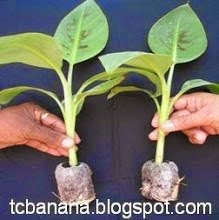
    What you have received now from our Chief Guest is a Banana plant (Variety : Grande Naine) raised by Tissue culture production technology. A brief description about how to plant it in your sweet home and it’s cultivation methods are given hereunder.
    1.      The plants you have received today are very young and must be planted the next day morning. 
    2.      You might have noticed that the plants have young white roots entangling the root ball which needs to be moistened always before planting into the field.  Therefore water the plants intermittently.
    3.      If you wish to plant them leisurely then they should be kept in a place where there is partial shade and avoid exposure to direct sunlight.
    4.   Start planting in a well prepared spot preferably in the evening hours and irrigate it immediately.
    5.      Dig a circular pit  (Size 11/2 feet diameter and 1 feet depth) in your garden preferably in the place where your kitchen waste water percolates. Throughout the cultivation period, stagnation of water should be avoided as this will lead to infection and subsequent rotting of plant.
    6.      Collect the following items at the time of planting:(1) Neem Cake 250 gms, (2) Ground nut Cake -  500 gms, (3) Farm yard Manure – 1 basket, (4) Vermicompost - 1 kg (5) Humic acid 10 gms and mix all the items along with the soil dug out from the planting pit and fill the pit with the mixture.
    7.      The net like bag holding the root zone of the given plant is made of biodegradable material. So there is no need to remove it and you can plant as such in the soil.
    8.   Planting depth should be maximum 1cm above the top level of bag. Deep planting should be avoided. Press the surrounding soil with hands firmly for compaction of ground and irrigate immediately.
    9.      Maintain the root zone under moist condition for 10-12 days.
    10. The emergence of new leaves indicates the establishment of plants in the soil. 
    11. Irrigation / Water requirement: Young plants need watering daily twice upto 3 months. First month:  5 litres daily twice, 2nd and 3rd month: 10 to 15 litres daily twice, 4th to 6th months: 20 litres daily once, 7th month: 25 litres daily and after 8th month upto bunch harvest: 35 litres daily.
    12. Weeding : Unwanted weeds that come up surrounding the plant for up to 6 feet radius are to be periodically removed as there will be competition for food.
    13. Management of daughter suckers : Banana plant normally produces numerous daughter suckers all around the plant after 3 - 4 months. These daughter suckers must be removed by sawing them up to the ground level. If you allow them to grow then the mother plant will produce smaller size bunch only. 
    14. Fertilizer application :
    a.      Apply 10 kg of Farmyard manure, 1 KG of Ground nut cake, 500 gms of Neem cake, 1Kg of Vermi-compost, 25 gms of Humic acid in powdered form, 5 kg of rice husk ash available in rice mills, 1 Kg of Rock phosphate, or any other organic sources available with you in a circular fashion all around the plant. (1 feet away on  3rd month, 2 feet away by 5th month and 21/2 feet away after 6th month). Apply Vermi and oilcakes alone by 7th  & 8th month for good bunch development. 
    b.     Quantity and periodicity of fertilizer application varies depending upon the soil fertility of your garden. If the plant growth is stunted, additional application of nutrient rich oil cakes are necessary.  
    15.  Propping: Banana plant is not sturdier enough to carry its own bunch. After bunch emergence you have to provide support to the developing bunch using poles. If not, the plant will collapse due to wind with immature fruits.
    16. Harvesting : Flower emergence takes place between 6-7 months. Development of bunch takes about 120 days. Normal size bunch is with 9 to 11 hands and are ready for harvest by 11th or 12th month. The correct time for harvest (maturity index) is when you notice roundness of the tip of fruits and change of colour from green to light green.
    17. Ripening : In India, 'Smoking method' is the age old and safe method to ripen  banana. In olden days each and every house had one windowless dark room usually under the stair case or at cattle shed exclusively for ripening banana bunches. Now we have to settle with any airtight plastic or stainless steel container. Place the harvested bunch along with 3 to 4 big green banana leaves in an air tight container for 2 days. Ripening will be hastened if you place some banana peels and other unripe fruits like Mangoes, tomatoes  Etc., along with banana.   
    Banana is the first fruit every baby gets as food after milk because its tastes great, easily digestible, and a store house of energy.  A fairly inexpensive fruit when compared to the value of nutrients inside its protective skin such as: vitamins A, B1, B2, B3, B5, B6, B9, Calcium, Iron, Magnesium, Phosphorus, Potassium and Zinc. 
    Think banana. Grow banana. Eat banana.
    Eat for your health and to help poor farmers who tirelessly build our nations wealth.

    For more details visit this link: www.tcbanana.blogspot.com.

    Total Pageviews

    Twitter Delicious Facebook Digg Stumbleupon Favorites More

     
    Design by Free WordPress Themes | Bloggerized by Lasantha - Premium Blogger Themes | fantastic sams coupons