For growth and prosperity

For growth and prosperity

Friday, 6 January 2012

FUNGAL DISEASE (Pre & Post - Harvest): CROWN ROT

CROWN ROT
Symptoms:
It is the most serious post harvest problem, especially where dehandling and boxing of fruit is not carried out in modern and centralized air-conditioned plants.

  • A number of fungi are associated with crown disorder viz.   Colletotrichum musae (C.musae), Fusarium spp, Vetricullium theobromae (V.theobromae) and Botryodipiodia theobromae (B.theobromae).
  • Blackening of the crown tissue occurs initially at the cut surfaces, but the rot may spread into the crown during transportation.
  • Rotting is most noticeable if transit time exceeds 7 days and high incidence of disease may cause premature ripening of the fruits.

Control:
Dip or spray the harvested hands with 0.05% Bavistin.


Thursday, 5 January 2012

FUNGAL DISEASE (Pre & Post Harvest): CIGAR END ROT

CIGAR END ROT

Symptoms: 

Two fungi are associated with this disease viz. verticillium theobromae (V.theobromae) & Trachyspaera fructigena (T.fructigena). The fungus attacks at the flowering stage and its incidence is spotted during rainy season. Spray of Bavistin @ 1 gm/lt or Kavach (Chlorothalonil) @ 1gm / lt of water on the bunches is recommended.:
  •   As the fruit develops, the infection spreads slowly along with the fruit growth  causing blackening of the skin. 
  •   Tip of the infected fingers later gets covered with a powdery mass of spores resembling grey ash end of a cigar. 

Control: 
  • Removal the untransformed flowers after the finger emergence. 
  • Spray the bunches with Bavistin @ 1 gm/lt or Kavach (Chlorothalonil) @ 1gm / lt of water once in 15 days and later on cover the bunches with polythene sleeve. 


    FUNGAL DISEASE (Pre & Post - Harvest): ANTHRACNOSE

    ANTHRACNOSE

    Symptoms: 

    It is a serious pre and post harvest disease caused by Colletotrichum musae.
    • Infection starts at the distal end of the young harvested fruits as minute black spots, spreading slowly to the whole fruit which eventually turns black and shriveled. It spreads to the other hands through the stalk affecting the    whole bunch. 
    •  On ripening fruits, the symptoms appear as sunken  brownish lesions which get covered  by salmon colored    fungal sporulation. Lesions expand faster and coalesce giving a black appearance to the fingers.
    Control:
    Spray bunches twice with 0.25% Indofil M-45 or 0.25% Kavach at 15 days interval.


    FUNGAL DISEASE (Foliar) : PANAMA WILT.

    PANAMA WILT (OR) FUSARIUM WILT 

    Symptoms:
     Panama wilt is caused by Fusarium oxysporum f.sp. cubense. Both external and internal symptoms are present in the affected plant.
    • Symptoms commence as yellowing of older leaves and progresses to youngest leaf. 
    • The affected leaves collapse gradually at the petiole and hang around the Pseudostem. 
    • At advanced stages of the disease development, splitting of the Pseudostem occurs coinciding with the collapse of crown.
    Wilt is a vascular disease and attacks the conducting tissues. A transverse section of the Pseudostem/leaf base/rhizome exhibits presence of wilt fungus in the form of purplish or brownish-black discoloration of the vascular bundles that disrupts the translocation of nutrients leading to collapse of foliage and cessation of the growth of the crown.

    Control: 
    • Provide good drainage in field wherever water stagnation occurs. 
    • Bimonthly drenching and weekly spray with 0.1% Bavistin for 2-3 weeks on and around the infected plants. 
    • Uproot severely infected plants and burn them. Liming of the infected soil at the site of uprooted plants, helps in reducing the survival of fungus.
    Click this link for: 


     Regards,
    A.Vishnu Sankar

    FUNGAL DISEASE (Foliar) : CORDANA LEAF SPOT.

    CORDANA LEAF SPOT 

    This disease is caused by Cordana musae. (C.musae).

    Symptoms: 
    1. The fungus produces individual brown lesions which are upto several centimeters in length with a dark margin and surrounded by a chlorotic halo. 
    2. The lesions enlarge in size, coalesce, and produce necrotic areas. Ultimately, the leaves turn brown and dry out. 

    Control Measures:

    Spray 0.25% Kavach or 0.25% Indofil M-45 or 0.1% Tilt at 15 days interval.


    Wednesday, 4 January 2012

    FUNGAL DISEASE (Foliar) : YELLOW SIGATOKA (Sigatoka Leaf Spot)


    YELLOW SIGATOKA (Sigatoka Leaf Spot):

    Symptoms:
    In India, it is caused by Cercospora musae (C.musae), the asexual form of Mycosphaerella fijiensis.
    • Symptoms start as tiny, yellow broken streaks followed by the development of brown spindle shape lesions in the streaked areas with a yellowish halo.
    • Slowly lesions darken and become elliptical brown spots with a grayish centre demarcated by a well defined brown or black border.
    •  These lesions coalesce and enlarge causing death of leaf blade.
    • This results in reduced photosynthetic area and eventually reduced harvestable yield coupled with accelerated fruit maturity and immature ripening.
     Control Measures:
    • Keep the orchard clean, remove the diseased leaves and burn outside the plantation. 
    • Make proper drainage of water to avoid water logging. 
    • Contact fungicide Mancozeb(2.5gm / lt) or Calixin (2ml/lt) with Teepol (Sticking agent ) must be sprayed during initial symptoms. 
    • During severe infection Bavistin @ 2gm / lt or 0.1% Tilt can also be used and repeat at 15 days interval. 
    • Increment in Potassium in the fertilizer dose and 6 feet X 6 feet spacing in plantation minimizes the infestation.


    Wednesday, 9 November 2011

    Feed back from TNAU, NRCB and Farmers

    Dear readers,

    You are aware that this blog carries an exhaustive load of details regarding micro-nutrient deficiencies in Banana and their remedies.

    On cross verification with other websites it was found that even the most trusted websites carry major flaws.

    TNAU Agritech portal is no exception and the mistakes pointed out by this blogger was corrected in their website immediately (within 12 hours). 

    The above discussed subject along with the disputed pictures were sent to National Research Centre for Banana, Trichy also for re-confirmation at their end. Fast came the reply to our surprise.

     'KUDOS' to TNAU and NRCB on behalf of farming community for their quick response.

    Our letter and the response from both TNAU and NRCB is given here for record:
     
    Dear Mr. Sankar,
    Thanks for the mail and information,
    We accept the link was a mistake and rectified immediately,
    We will welcome constructive suggestion to improve on,
    With kind and warm regards
    N. Anandaraja,
    Asst. Prof (AEX)
    TNAU
    On Mon, Nov 7, 2011 at 1:16 PM, Vishnu Sankar <vishnusankar@ymail.com> wrote:

    Respected sir,
    I regret to note some major flaws in your Agritech portal in the link:
    In the above link, some pictures are published under the heading ‘Deficiency symptoms of Banana’.  These pictures are copied from NRCB website http://www.nrcb.res.in/soil.html.
    1.    Mistake 1: The picture shown as P deficiency is actually S deficiency as per NRCB website link: http://www.nrcb.res.in/soil.html.
    2.    Mistake 2: The picture shown as Mn deficiency is actually Mg deficiency as per NRCB website link: http://www.nrcb.res.in/soil.html.
    3.    Mistake 3: The picture shown as S deficiency has two different pictures combined in to one picture. In actual, the upper picture shows Zn deficiency and the lower one depicts S deficiency as per NRCB http://www.nrcb.res.in/soil.html.
    Please correct the mistakes immediately which might have occurred by oversight at your end.
    Thanking you,
    Yours Sincerely,
    A.Vishnu Sankar


    --
    Dr. E. Vadivel
    Project Officer (e-Extension)
    e-Extension Centre
    Directorate of Extension Education
    Tamil Nadu Agricultural University
    Coimbatore-641 003
    Ph:   0422-6611383
    Fax: 0422-6611521
    The mail received from NRCB:
    From

    Dr.K.J.Jeyabaskaran, Senior Scientist (Soil Science),
    National Research centre for Banana,
    Tiruchirapalli - 620 102 (Tamil Nadu)
    Dear Mr. Vishnu Sankar,
    Please refer to your e-mail to directornrcb@gmail.com dt 7-11-2011. The photographs depicting nutrient deficiency symptoms found in our website, http://www.nrcb.res.in are from authentic source (from our experimental fields). They are CORRECT.
    With regards,
    Yours Sincerely,
    K.J.JEYABASKARAN

    Feed Back from our Beloved farmers:

    Dear Sir,
    I am _______, a banana farmer from Mysore. I'd like to express my sincere thanks to you for your very informative blog on TC banana. It helped me a lot in getting an excellent yield of 55kg avg. 

    Attached some of the photos from my farm. 


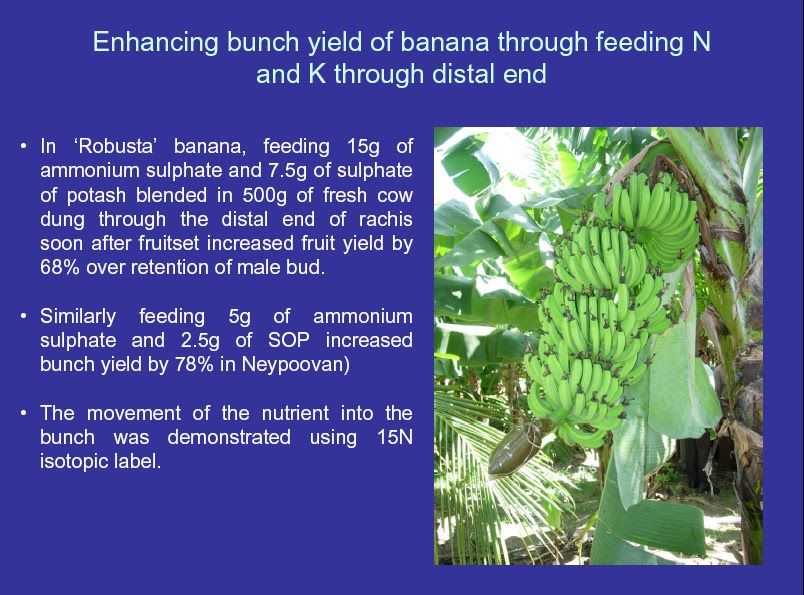
    Enhancing bunch size of Banana through feeding N and K through distal end of rachis:

    Dear reader,
     You are kindly requested to visit the link: "Banana Bunch Care and procedures to maximize the bunch size", which is a must read article that covers all aspects of bunch care and proven methods to increase the bunch size, before commence reading the following article. Thank you.

    Maximizing banana bunch size by feeding  N and K through distal end of rachis:
    There is considerable increase in bunch size in ‘Robusta’ and ‘Grande naine’ banana, when feeding the following mixture through the distal end of rachis soon after fruitset.  
    Preparing the nutrient mixture:
    • Ammonium Sulphate            -           15gm
    • Sulphate of potash (SOP)    -           7.5gm
    •  Fresh cow dung                    -           500gm blended in 100 ml of water.
    (Cow urine can also be used instead of water. 500 gm of fresh cow dung contains substantial amounts of about 5.5gm of N, 3.5gm of K 1.6 gm of S besides other minerals and bio-chemicals).
    Method of application:
    v     Select bunches where the fruit set is complete and about 10 – 15 cm long rachis is available after the last hand. Avoid bunches where fruit set is incomplete or during partial deflowering time.
    v     Remove male flower bud close to the rachis.
    v     Take the already prepared nutrient slurry in a used milk bag.
    v     Insert the slurry filled bag into the de-navelled stalk end of the bunch and tie it with a strong string.
     Benefits:
    Ø      Bunch weight increased by 67% over control in which male flower bud was retained till harvest. In the field demonstrations, a response of 22 % to 28% increase in bunch weight was evident. Using ‘N-isotope label the movement of 51% of N into the bunch from AmSo4 was confirmed.
         (Courtasy: ICAR News, Research update, Success story, April – June 2007).
    For elaborate details on "Banana Bunch Care and procedures to maximize the bunch size" click this LINK.

    (Readers are requested to visit this link: 'Effect of excessive application of chemicals  on bunch'  also before exiting this page).

    Monday, 26 September 2011

    FERTILIZER TARGET CHART FOR BANANA UNDER PRECISION FARMING:

    FERTILIZER TARGET CHART FOR BANANA ADOPTING
    PRECISION FARMING TECHNOLOGY:

    CAUTION: REQUIREMENTS GIVEN HERE ARE TARGETS ONLY,
    SO DO NOT APPLY THE GIVEN QUANTITY AT THE GIVEN AGE.
    T A R G E T


    GROWTH STAGE
    Age
    Requirement in gms/plant
    Requirement in %


    N
    P
    K
    N %
    P%
    K%
    EARLY ESTABLISHMENT STAGE -I
    30
    30
    30
    10


    45
    45
    40
    20


    60
    60
    60
    40
    21
    50
    11
    ESTABLISHMENT STAGE -II
    90
    90
    80
    80


    120
    110
    90
    120
    19
    25
    21
    VEGETATIVE STAGE -III
    150
    150
    120
    160


    180
    180
    120
    200


    210
    200
    120
    240
    32
    25
    31
    SHOOTING STAGE- IV
    240
    230
    120
    270


    270
    260
    120
    310


    300
    280
    120
    350
    28
    0
    29
    DEVELOPMENT OF BUNCH AND HARVESTING STAGE -V
    330
    do
    120
    380
    0
    0
    8


    280
    120
    380
    100
    100
    100


    CAUTION: REQUIREMENTS GIVEN HERE ARE TARGETS ONLY,
    SO DO NOT APPLY THE GIVEN QUANTITY AT THE GIVEN AGE.

    Regards,
    A.Vishnu Sankar

    Using Pseudostem injector for effective control of Fusarium wilt, Erwinia rot and Weevil attacks.

    A novel method for effective control of Fusarium wilt, Erwinia rot and Weevil attack in Banana plants.

    Using Pseudostem injector:

    Step 1:

    Prepare a solution of 700ml of water + 300ml of Monocrotophos + 20 gms of Carbendazim + 1 gm of Streptomycin with Tetracycline sulphate.

    Step 2:

    Take the above solution in a Pseudostem injector. Dig the soil to expose the banana corm and inject 3 ml to 5 ml of the above solution directly into the corm.


    Step 3:

    Inject an additional dose of 3ml to 5 ml of the prepared solution to the Pseudostem 2 feet above ground level in a 45 degree slanting angle.

    • In severely affected plantations administering a second dose of the above solution is necessary within 15 days for an effective control.
    • Usage of 'Pseudostem injector' is recommended for above 3 months old banana plants only.
    • Avoid inserting the needle beyond 2” as it will harm the main stem.
    • Fusarium wilt (Panama wilt), a fungal disease caused by Fusarium oxysporum is a major disease prevalent in banana growing belts. This fungal disease can be effectively prevented by this solution since it contains Carbendazim - a wide spectrum systemic fungicide (2% concentration) which is administered directly into the affected parts.
    • Erwinia soft rot (Head rot, snapoff, tipover) and Moko bacterial wilt are some bacterial attacks normally affecting tissue culture banana plants. These bacterial attacks are also prevented by the above solution because of the antibiotic ingredient Streptomycin and Tetracycline sulphate in it.
    • Rhizome weevil and Pseudostem borer are some of the major pests affecting banana plantations. By injecting the above solution containing Monocrotophos, a systemic insecticide the weevils and the borers will be killed. The adult weevil feed on Pseudostem and the young larvae on the rhizome so injection in both the plant parts is recommended.
    • Click this link: Panama or Fusarium Wilt, to know more about this fungal disease.  
      
    A.Vishnusankar

    Total Pageviews

    Twitter Delicious Facebook Digg Stumbleupon Favorites More

     
    Design by Free WordPress Themes | Bloggerized by Lasantha - Premium Blogger Themes | fantastic sams coupons