For growth and prosperity

For growth and prosperity

Monday, 26 September 2011

FERTILIZER TARGET CHART FOR BANANA UNDER PRECISION FARMING:

FERTILIZER TARGET CHART FOR BANANA ADOPTING
PRECISION FARMING TECHNOLOGY:

CAUTION: REQUIREMENTS GIVEN HERE ARE TARGETS ONLY,
SO DO NOT APPLY THE GIVEN QUANTITY AT THE GIVEN AGE.
T A R G E T


GROWTH STAGE
Age
Requirement in gms/plant
Requirement in %


N
P
K
N %
P%
K%
EARLY ESTABLISHMENT STAGE -I
30
30
30
10


45
45
40
20


60
60
60
40
21
50
11
ESTABLISHMENT STAGE -II
90
90
80
80


120
110
90
120
19
25
21
VEGETATIVE STAGE -III
150
150
120
160


180
180
120
200


210
200
120
240
32
25
31
SHOOTING STAGE- IV
240
230
120
270


270
260
120
310


300
280
120
350
28
0
29
DEVELOPMENT OF BUNCH AND HARVESTING STAGE -V
330
do
120
380
0
0
8


280
120
380
100
100
100


CAUTION: REQUIREMENTS GIVEN HERE ARE TARGETS ONLY,
SO DO NOT APPLY THE GIVEN QUANTITY AT THE GIVEN AGE.

Regards,
A.Vishnu Sankar

Using Pseudostem injector for effective control of Fusarium wilt, Erwinia rot and Weevil attacks.

A novel method for effective control of Fusarium wilt, Erwinia rot and Weevil attack in Banana plants.

Using Pseudostem injector:

Step 1:

Prepare a solution of 700ml of water + 300ml of Monocrotophos + 20 gms of Carbendazim + 1 gm of Streptomycin with Tetracycline sulphate.

Step 2:

Take the above solution in a Pseudostem injector. Dig the soil to expose the banana corm and inject 3 ml to 5 ml of the above solution directly into the corm.


Step 3:

Inject an additional dose of 3ml to 5 ml of the prepared solution to the Pseudostem 2 feet above ground level in a 45 degree slanting angle.

  • In severely affected plantations administering a second dose of the above solution is necessary within 15 days for an effective control.
  • Usage of 'Pseudostem injector' is recommended for above 3 months old banana plants only.
  • Avoid inserting the needle beyond 2” as it will harm the main stem.
  • Fusarium wilt (Panama wilt), a fungal disease caused by Fusarium oxysporum is a major disease prevalent in banana growing belts. This fungal disease can be effectively prevented by this solution since it contains Carbendazim - a wide spectrum systemic fungicide (2% concentration) which is administered directly into the affected parts.
  • Erwinia soft rot (Head rot, snapoff, tipover) and Moko bacterial wilt are some bacterial attacks normally affecting tissue culture banana plants. These bacterial attacks are also prevented by the above solution because of the antibiotic ingredient Streptomycin and Tetracycline sulphate in it.
  • Rhizome weevil and Pseudostem borer are some of the major pests affecting banana plantations. By injecting the above solution containing Monocrotophos, a systemic insecticide the weevils and the borers will be killed. The adult weevil feed on Pseudostem and the young larvae on the rhizome so injection in both the plant parts is recommended.
  • Click this link: Panama or Fusarium Wilt, to know more about this fungal disease.  
  
A.Vishnusankar

Sunday, 11 September 2011

Fertilizer burn - Effect of excessive use of chemical fertilizers,

What is fertilizer burn?
The chemical fertilizers that we use for farming are hygroscopic in nature. When a farmer applies excess chemical nutrients and fails to water the plants sufficiently, the applied chemicals because of their “thirsty” nature starts absorb water particles not only from the soil but also from the plant roots.

This withdrawal of water from the plant tissues (dehydration) will cause ‘drying out’ of tender parts like roots and foliage. This injury will be visible very soon after the application of fertilizers like browning of part or all of the foliage. In some cases, severe injury will cause death of the entire plant. Since the symptoms in the leaf look like 'thermal radiation burn out' this is called “Fertilizer burn’.

Remember: “Over fertilizing is just as bad as under fertilizing”.
Fertilizers are normally soluble but some are highly soluble. The higher the solubility of a chemical fertilizer then higher the chances of “burn” if not used properly.

In most of the ‘burn out’ cases, it was found to be the application of excess nitrogen beyond the needs of the plant that caused the plant burn.

A case history:


Fertilizer burn may occur to plants that are provided with drip / fertigation system also.

Continuous fertigation, less water and hot climatic condition may cause ‘burn’ as happened to a Banana farmer who had applied 200gm of Single Super Phosphate and 100gm of Di Ammonium Phosphate as basal fertizers and after a week started to give daily dose of 1gm each of Ammonium Sulphate, Urea, Calcium nitrate, Potash and water soluble 19:19:19 (Total 6gm per Banana plant). The inevitable ‘burn’ happened one hot noon and the farmer was advised to stop fertigation and asked to irrigate the plant copiously.

Pictures taken on 01/09/2011 at his field (Uthamapalayam, Theni District, Tamilnadu) are published here above.

Remedy:

Irrigate copiously to leach (wash out) the excess chemicals from the soil.

Regards,
A.Vishnu Sankar

Friday, 9 September 2011

Effect of excessive dose of MKP and Urea when used them for banana bunch development

Dear reader,
 You are kindly requested to visit the link: 
which is a must read article that covers all aspects of bunch care and proven methods to increase the bunch size, before commence reading the following article. Thank you.

A case of excessive dose of MKP and Urea when used them for banana bunch development and its detrimental effect:

The two pictures shown here under were taken at a field where the farmer was asked to spray 0.5% MKP (Mono potassium phophate) + 1% Urea on bunches for bunch development. This wrong selection and overdose of chemicals has resulted in total spoilage of the bunch due to abnormal elongation of fingers (11 to 12 inches) and very thin fingers with no scope for further development. (See the lesions in the peduncle). 


To avoid damage to the developing Banana bunch learn to use fertilizers judiciously.
At the banana bunch development stage the following fertilizers are  normally recommended to enhance the size of fruits / bunch: 

Option 1: Application of 2% (20gm / 1litre) Potassium sulphate (0:0:50) as foliar spray on bunches, two times with 15 days interval.
(OR)
Option 2: Application of 1% (10gm / 1litre) Potassium nitrate (13:0:45) as foliar spray on bunches, two times with 15 days interval.
(OR)
Option 3 (Considered as best since it addresses all nutritional deficiencies): Application of 0.5% (5gm / 1litre) Potassium nitrate (13:0:45) + 0.5% (5gm / 1litre) of foliar grade Micro nutrient mixture as foliar spray on bunches as first spray followed by a second application of 2% (20gm / 1litre) of Potassium sulphate (0:0:50) + Biozyme 2ml / 1litre after 15 days. Repeat the second one again as III application after 15 days interval.

Important Note 1: In all the above applications you can also add 0.2% Bavistin (Fungicide) for prophylactic control of fungal infections. Use wetting agents also. 


Important Note 2: Nowadays farmers are going for a minimum of four applications within a period of 60 days (4 sprays with 15 days interval between each spray) and are getting very good results. 

Precautions: 
  • Care should be taken to spray the above fertilizers only after all the hands are fully opened and after sufficient extension of male flower bud in the rachis. 
  • Do not apply any fertilizers or pesticides 15 days before harvest since there is a possibility of the unabsorbed chemical residues entering human food chain.
  • Application of excess dosage of fertilizers, Enzymatic and synthetic Growth promoters and plant protection chemicals on bunches are to be strictly avoided.


Good quality bunches that were sprayed with SOP, Multi K, foliar grade M.N and Biozyme solution.


Regards, 
A.Vishnu Sankar


Wednesday, 7 September 2011

Effect of excessive dose of Hexaconazole fungicide (Contaf) on Banana

Effect of excessive dose of Hexaconazole fungicide (Contaf) on Banana:

Hexaconazole is a systemic, broad-spectrum fungicide mainly used on banana. It is widely used to control rhizome rot, corm dry rot and root rot in banana and the application rate is 1ml to 1.5ml per plant for rootzone drenching. Application of the above fungicide @1ml in 200 ml of water for drenching around the plant is enough for a month old plant, 1.25 ml in 500 ml for 2 months old and 1.5 ml in1litre for plants above 3 months.

Here in the two pictures published here below, the injury caused to the the outer layers of the pseudo stem and the leaves is because of the root-zone application of Hexaconazole @ 6ml / 1litre for 3 month old plants by the farmer by mistake. Banana plants collapsed fully in places where he applied 2 litre of the above solution.


Injury due to Gramoxone herbicide spray on Banana

Injury due to Gramoxone herbicide spray on Banana: 

The pictures published down here under show injury to banana plants due to spraying of Gramoxone herbicide without spray hoods. During herbicide application, whether it is Gramoxone or Glyphosate, the following precautions should be taken:



  1. Use only recommended dose of herbicide. 
  2. Use spray nozzles that are specially designed for weedicide / herbicide application. 
  3. Apply them under low pressure. 
  4. Do not speed. A slow move, slower than the normal leisurely walk is the ideal speed for herbicide application. 
  5. Use spray hoods mounted on spray nozzles to prevent the herbicide product to escape and cause crop injury. 
  6. During spraying the spray hood should be as close to the ground as possible make sure the hood is on the ground until it has fully moved past the plant. Raise the hood only after turning off the spray.
    Regards, 
    A.Vishnu Sankar

Friday, 22 July 2011

Copper (Cu) deficiency symptoms

Copper (Cu) deficiency symptoms:

    • Leaf mid rib and veins bend backwards resulting in umbrella shape appearance of the plants.
    • Leaves appear yellow-bronze in colour.

Control Measures:

  1. Spray copper sulphate @ 2g/l of water (neutralized with lime) at weekly interval for 2-3 weeks.


Tuesday, 19 July 2011

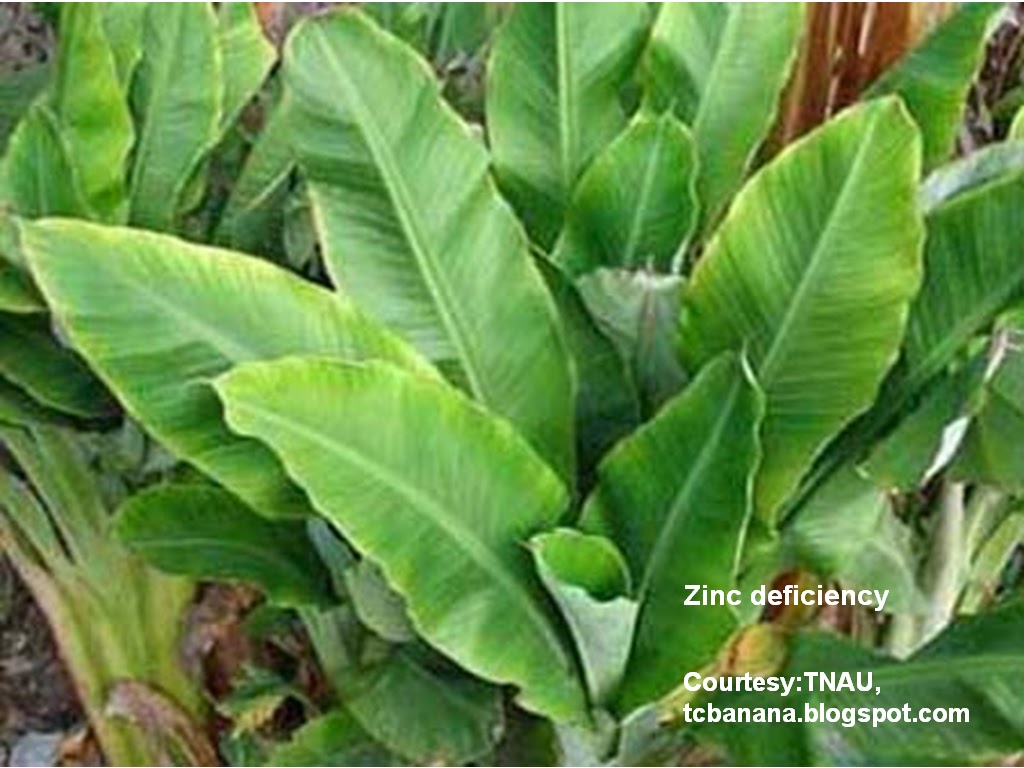
Zinc (Zn) deficiency symptoms

Zinc (Zn) deficiency symptoms:

  • Narrow pointed and chlorite young leaves, bunchy top crowns are the symptoms of zinc deficiency which is often falsely identified as BBTV by the farmers.
  • The young emerging leaves have high amount of anthocyanin pigment on the lower side of the leaves, which often disappears as the leaf unfolds.
  • Leaves are narrow with yellow to white stripes between the secondary veins.
  • Later on oblong, brown or necrotic patches develop on the yellow striped areas.
  • The leaves of the young suckers may become distorted, comprising of mid-rib and serrated narrow lamina only.
  • Bunches developing on such plants have twisted fingers with prominent light green tip.
  • The characteristics symptoms appear in young leaves which become significantly smaller in size and more lanceolate in shape.
Control Measures:
    1. Manual application of Zinc sulpahte @ 2g/plant.
                                                (OR)
    1. Spray chelated Zinc @ 2-3 g/1 of water at 7-10 days interval till deficiency symptoms disappear.
    2. For ratoon crop apply the above preparation 45 days after cutting the mother plant.
    3. The bunchy top crowns shown in the picture below are the symptoms of zinc deficiency which is often falsely identified as BBTV by the farmers.


    Thursday, 14 July 2011

    Boron (B) deficiency symptoms

    Boron (B) deficiency symptoms:

    • Symptoms include marginal leaf curing and deformation, and most commonly white stripes appear perpendicular to the veins on the young emerging leaves.
    • The new leaves may have an incomplete lamina similar to sulphur and calcium deficiency with thickening of secondary veins.
    • Inhibition of root and flower formation is also observed in the affected plants.
    • Boron and Calcium deficiency symptoms tend to overlap. See Calcium deficiency pictures also. 
    • Once a plant shows of signs of deficiency, take immediate remedial steps suggested here below, since the plants will not fully recovery once the damage is already happened.
    Control Measures:

    a.  Apply 10g Borax/plant in 3rd month or when deficiency occurs, once only. 
                                                    (OR)
    b.  Spray Boric acid @ 1g/litre of water 2-3 times, weekly.
                                                    (OR)
    c. Spray Solubor @ 1g/litre of water 2 times in a month. (Excess application will harm the plant).
                                                    (OR) 
    d. Apply Sodium tetraborate @ 25 gms per plant and irrigate immediately.

    Picture 1: Boron deficiency symptom:
    (The central new leaves have incomplete lamina).

    Picture 2: Boron deficiency symptom:
    (The central new leaves have incomplete lamina).


    Picture 3 Boron deficiency symptom:
    (The central new leaves have incomplete lamina).


    Picture 3 Calcium + Boron deficiency symptom: Deformed and whitish heart leaf. 

    Picture 4: Early foliar symptom of calcium + boron deficiency - Wrinkled leaf.


    Picture 5: Early foliar symptom of calcium + boron deficiency- Spike leaf in which the lamina of new leaves is deformed or almost absent). 


     Picture 6: Boron deficiency symptom: Deformed leaves and improper filling and cracking of fruits.

    Regards,
    A.Vishnu Sankar

    Total Pageviews

    Twitter Delicious Facebook Digg Stumbleupon Favorites More

     
    Design by Free WordPress Themes | Bloggerized by Lasantha - Premium Blogger Themes | fantastic sams coupons